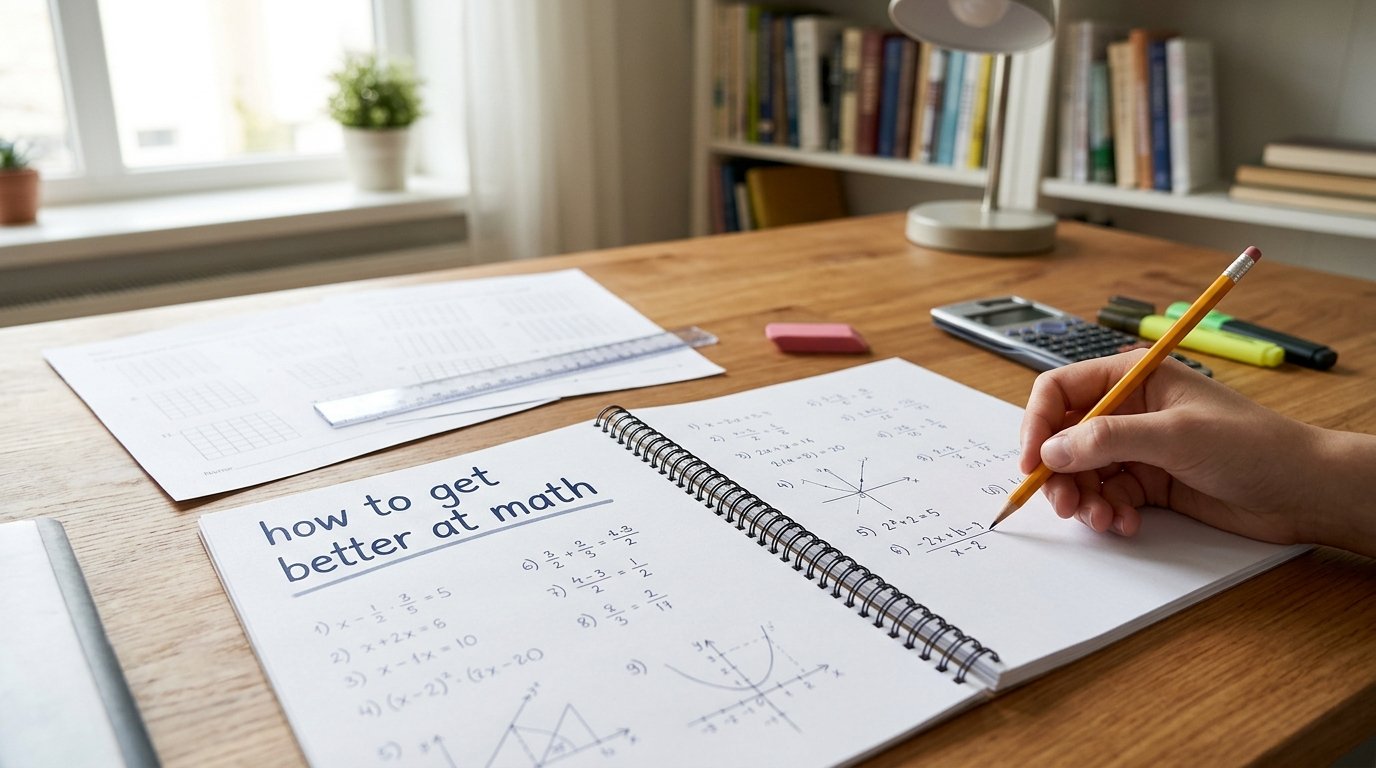
Getting better at math does not require a special talent or a perfect memory. If you want to improve your grades, solve problems faster, or feel more confident with numbers, you can make steady progress with the right habits.
The key to learning math is to understand the basics, practice regularly, and learn from your mistakes. You do not need to study for hours every day. A simple plan, a little patience, and the right practice methods can help you build stronger math skills over time.
Quick Answer
To get better at math, review the basics, identify your weak areas, and practice problems every day. Learn why each step works instead of memorizing answers. Check your mistakes, ask questions when you get stuck, and gradually try harder problems. Use short study sessions and track your progress to build confidence.
What You Need Before You Start
You do not need expensive tools or a special course to improve your math skills. A few basic supplies and a willingness to practice are enough.
Use this simple checklist to get started:
- A notebook: Write down formulas, examples, and mistakes you want to remember.
- A pencil and paper: Work through problems by hand instead of relying on mental calculations alone.
- Practice problems: Choose exercises that match your current skill level.
- A regular study time: Set aside 15 to 30 minutes on most days.
- A positive mindset: Accept that getting some answers wrong is part of learning.
If you struggle with a particular topic, start with easier questions before moving to more difficult ones.
How to Get Better at Math Step by Step
Follow these 10 steps to improve your math skills, understand difficult topics, and become more confident when solving problems.
1. Find Out Which Math Skills You Need to Improve
Before you start studying, figure out what is giving you trouble. You might understand multiplication but struggle with fractions, or you may know the rules of algebra but have difficulty solving equations.
Try solving five to ten problems from the topic you want to improve. Notice which questions take too long, which ones you get wrong, and which ones you cannot start.
Write your weak areas in your notebook. For example, your list might include fractions, negative numbers, percentages, and word problems.
Why this works: When you know exactly what needs attention, you can spend your study time wisely instead of reviewing everything at once.
2. Strengthen Your Basic Math Skills
Many difficult math problems become easier when you understand the basics. Addition, subtraction, multiplication, division, fractions, decimals, and percentages support many later topics.
If you struggle with algebra, for example, you may need to review negative numbers or the order of operations first. The order of operations tells you which calculations to complete first in an expression.
Practice one basic skill until you can solve familiar problems correctly without constantly checking the rules.
Do not rush through the early topics just because they seem simple. Strong foundations make it easier to learn more advanced math.
3. Practice Math Every Day
Regular practice is one of the most useful ways to improve. Studying for 20 minutes on most days can be easier to maintain than doing several hours of work once a week.
Start with a short session:
- Spend five minutes reviewing an old topic.
- Spend ten minutes solving practice problems.
- Spend five minutes checking your answers and correcting mistakes.
Adjust the timing to fit your schedule and attention span.
As you improve, add more challenging questions. If a problem feels too difficult, return to an easier example and work your way up.
The goal is to build a habit you can maintain, not to force yourself to study until you feel exhausted.
4. Understand the Steps Instead of Memorizing Answers
Memorizing formulas can help, but it is not enough if you do not understand how to use them. You need to know why a method works and when it applies.
For example, consider this equation:
\(3x + 5 = 20\)
To find \(x\), subtract 5 from both sides:
\(3x = 15\)
Then divide both sides by 3:
\(x = 5\)
The answer is 5 because both operations keep the equation balanced.
After studying an example, close your notes and solve it again from memory. Then try a similar problem with different numbers.
If you can explain why each step works, you are building understanding rather than simply copying a pattern.
5. Break Difficult Problems Into Smaller Steps
A long math problem can seem confusing when you try to solve everything at once. Breaking it into smaller parts helps you focus on one task at a time.
Read the question carefully and identify what you know, what you need to find, and which mathematical operation might help.
For a word problem, you can use this process:
- Read the problem and identify the important information.
- Write down the question you need to answer.
- Choose the appropriate operation or formula.
- Solve one step at a time.
- Check whether your answer makes sense.
For example, if five notebooks cost $15 in total, divide $15 by 5 to find the price of one notebook. Each notebook costs $3.
This approach works for arithmetic, algebra, geometry, and many other math topics.
6. Learn From Your Mistakes
Getting an answer wrong does not mean you are bad at math. It gives you information about what you need to practice next.
When you make a mistake, do not immediately erase your work and copy the correct answer. Find the exact step where your thinking went wrong.
You may have made a calculation error, misunderstood the question, used the wrong formula, or skipped an important step.
Keep a simple mistake log with three details: the original problem, the mistake you made, and the correct method.
Review this log every few days. Try solving the same type of problem again without looking at the solution.
Over time, you will begin to recognize common errors and avoid repeating them.
7. Use Different Ways to Learn Math
Sometimes, reading a textbook explanation is not enough. A different teaching method may make the same idea much easier to understand.
Try combining several learning methods:
- Written examples: Follow each calculation step on paper.
- Visual explanations: Use diagrams, number lines, shapes, or graphs.
- Verbal explanations: Explain a concept aloud in your own words.
- Real-life examples: Use shopping, cooking, budgeting, or measurements to practice.
For example, fractions may become easier when you draw a circle divided into equal parts. Algebra may make more sense when you use a balance-scale drawing to represent both sides of an equation.
If one explanation does not work, try another. Needing a different explanation is normal and does not mean you cannot learn the topic.
8. Test Yourself Without Looking at the Answers
Reading a worked example can make a topic feel familiar, but familiarity does not always mean you can solve the problem independently.
After reviewing a lesson, put your notes away and complete a few questions on your own. This is called active recall, which means retrieving information from memory instead of simply rereading it.
Start with problems you have already practiced, then move to unfamiliar ones.
Check your answers only after you have made a genuine attempt. If you get something wrong, review the method and try a similar question again.
This process helps you discover what you truly understand and what still needs work.
9. Apply Math to Everyday Life
Math becomes easier to understand when you can connect it to situations outside the classroom.
Look for small ways to use numbers during your normal routine. These activities can help you practice without making every session feel like homework.
For example, you can:
- Calculate a 20% discount on an item.
- Split a restaurant bill between several people.
- Double or halve a recipe.
- Compare prices to find the better deal.
- Estimate how long a trip will take.
- Calculate how much money you can save each month.
These examples help you understand why mathematical skills matter. They also let you practice calculations in situations where the answers have a clear purpose.
10. Track Your Progress and Increase the Difficulty
It can be hard to notice improvement when you focus only on your latest test score. Track smaller achievements so you can see how your skills develop.
Record the topics you study, the number of problems you solve correctly, and the mistakes you make most often.
Once you can solve basic problems accurately, try more challenging questions. Mix older topics with new ones so you do not forget what you have already learned.
Use the table below to identify your next step based on your current difficulty.
| Your main difficulty | What to practice | How to check progress |
|---|---|---|
| Basic calculations | Addition, subtraction, multiplication, and division | Solve problems accurately with less help |
| Fractions and decimals | Equivalent fractions and conversions | Solve mixed practice questions |
| Algebra | Equations and negative numbers | Explain each step in your solution |
| Word problems | Identifying information and choosing operations | Set up equations independently |
| Geometry | Shapes, angles, and area formulas | Solve problems using diagrams |
| Slow calculations | Repeated practice with familiar problems | Improve speed without losing accuracy |
| Test anxiety | Timed practice and relaxation techniques | Complete practice tests more calmly |
| Repeated mistakes | Reviewing incorrect answers | Make fewer errors on similar questions |
Remember that progress may look different for different people. Focus on improving your own accuracy and understanding instead of comparing your results with someone else’s.
Common Math Mistakes and How to Fix Them
Even motivated students can develop habits that slow down their progress. Recognizing these mistakes can help you study more effectively.
Trying to Learn Everything at Once
Jumping between fractions, algebra, geometry, and statistics can leave you feeling overwhelmed.
How to fix it: Choose one main topic for each study session. Move to another topic after you understand the essential ideas and can solve practice problems independently.
Memorizing Formulas Without Understanding Them
A formula may help you answer one question, but you might not recognize when to use it in a different problem.
How to fix it: Learn what the formula represents, study a worked example, and practice using it in different situations.
Skipping Steps to Save Time
Doing calculations in your head may seem faster, but it can make mistakes harder to find.
How to fix it: Write down important steps, especially when solving equations or working with fractions. You can shorten your working later as your accuracy improves.
Giving Up After Getting an Answer Wrong
Repeated mistakes can make you feel frustrated, especially when other students seem to understand the topic quickly.
How to fix it: Treat each incorrect answer as a clue. Identify the problem, review the relevant rule, and attempt a similar question.
Studying Only Before a Test
Trying to learn several weeks of material in one night puts pressure on your memory and leaves little time to correct misunderstandings.
How to fix it: Study in short sessions throughout the week. Review older topics regularly and use practice questions to check your understanding.
Practical Tips for Beginners Learning Math
If you are starting from the beginning or returning to math after a long break, keep your approach simple.
- Start at your level. Do not feel embarrassed about reviewing elementary math if you need it.
- Set small goals. Aim to understand fractions or solve five algebra problems instead of trying to master an entire subject.
- Ask specific questions. Instead of saying, “I do not understand math,” identify the exact step that confuses you.
- Take short breaks. If you feel stuck, pause briefly and return with a fresh mind.
- Explain your reasoning. Describe how you reached an answer as if you were teaching someone else.
- Use a calculator wisely. Check arithmetic when appropriate, but practice the underlying skills so you understand the calculations.
- Be patient with yourself. Some topics take more practice than others, and that is normal.
If you consistently struggle with a topic despite regular practice, ask a teacher, tutor, classmate, or trusted learning resource for another explanation. A small misunderstanding can make later lessons much harder, so addressing it early is worthwhile.
Frequently Asked Questions
How long does it take to get better at math?
You may notice improvements in specific skills after a few weeks of regular practice, although more complex topics can take longer. Your progress depends on your starting point, study habits, and the difficulty of the material.
Can I get better at math if I am bad at it?
Yes. Struggling with math now does not mean you cannot improve. Building basic skills, practicing consistently, and learning from mistakes can help you develop stronger mathematical understanding.
How many hours a day should I study math?
Start with 15 to 30 minutes a day and adjust based on your goals and schedule. Focus on solving problems and understanding mistakes rather than simply spending more time with your books.
What is the fastest way to improve math skills?
Identify your weakest topic, review the necessary basics, and solve targeted practice problems. Check every mistake and repeat similar questions until you understand the method.
How can I get better at math without a tutor?
Use textbooks, worked examples, practice worksheets, educational videos, and self-testing. Write down specific questions when you get stuck, and seek help from a teacher or another knowledgeable person when you cannot resolve a misunderstanding.
How can I stop being afraid of math?
Start with manageable problems and gradually increase the difficulty as your confidence grows. Focus on learning rather than getting every answer right, and remember that mistakes are a normal part of the process.
Is practicing math every day better than studying once a week?
Regular practice is generally more effective for building lasting skills because it gives you repeated opportunities to review and apply what you learn. Short, consistent sessions also make it easier to identify and correct mistakes before they become habits.
Conclusion
Learning how to get better at math starts with a simple plan: strengthen your basics, practice regularly, understand each step, and learn from your mistakes. You do not need to master every topic at once.
Your next step: Choose one math topic you find difficult, spend 20 minutes practicing it today, and write down one mistake you learned how to fix. Repeat the process tomorrow, and build from there.

Hi, I am Gregory Stewart, a professional researcher and author on HowMeans.com. Every day, I dive deep into new and amazing searches to uncover hidden meanings and fascinating facts, keeping you informed and updated with everything you need to know.